The Gospel of Universal Heroism:
We Don't Need Another Hero
From Hero Worship to Heroic Living
Abstract
Throughout history, civilizations have depended upon heroes. From warrior-kings and prophets to saints, celebrities, and political saviors, societies have repeatedly concentrated hope, responsibility, and moral authority in exceptional individuals. Heroic leadership has often served an important developmental role, inspiring progress and preserving culture during earlier stages of human evolution. Yet the same pattern carries an inherent danger: dependency. Hero-centered cultures encourage admiration more readily than participation, spectators more readily than builders.
This essay proposes that one of the most revolutionary dimensions of Jesus' gospel has largely gone unnoticed. Rather than establishing a new hero-centered religion, Jesus proclaimed a kingdom designed to eliminate humanity's dependence upon heroes altogether. His ministry consistently shifted responsibility from the exceptional individual to every son and daughter of God. He trained disciples instead of admirers, distributed authority rather than accumulating it, and commissioned ordinary believers to continue the work of the kingdom. His leadership was intentionally multiplicative rather than arithmetically static.
Viewed through this lens, the gospel becomes far more than a message of personal salvation. It becomes a developmental blueprint for the progressive maturation of individuals, communities, and civilization itself. The kingdom advances not through the continual appearance of extraordinary personalities, but through the awakening of what may be called universal heroism—the discovery that every individual possesses both the privilege and the responsibility of participating in the Father's work.
Drawing upon insights from the sociology of religion, developmental psychology, leadership theory, and the cosmology of The Urantia Book, this essay argues that the modern challenge is not simply preserving a revelation about Jesus, but recovering the true gospel of the kingdom while progressing the movement Jesus began. The unfinished trajectory of the gospel is the transformation of a civilization organized around heroes into one organized around spiritually empowered disciples where greatness is measured less by those who stand above others than by those who help others become great.
How to Read This Essay
An Invitation to the Reader
This essay is intentionally ambitious. Rather than presenting a single argument, it braids together several lines of inquiry—including evolutionary anthropology, developmental psychology, mythology, sociology, leadership, and the teachings of Jesus—to explore one central question: Does the gospel of the kingdom invite humanity to outgrow its historical dependence on heroes?
At approximately 8,000 words, this is not a quick read. Nor is the accompanying podcast intended as background listening. Both move at a pace that assumes careful reflection.
You may find it best to approach the essay as a journey rather than a destination.
- Read slowly. There is no prize for finishing quickly.
- Pause occasionally to consider how each section connects to the central thesis.
- If an idea doesn't immediately resonate, continue reading before deciding. Later sections often illuminate earlier ones.
- You need not agree with every conclusion to benefit from the exploration. The goal is not merely to persuade but to invite fresh consideration of familiar ideas.
- If listening to the podcast, consider following along with the transcript or listening in shorter segments.
Above all, ask yourself one question as you read: What kind of disciples was Jesus actually trying to create?
Whether or not you agree with the conclusions, that question lies at the heart of everything that follows.
Listen to a summary podcast (19 mins.)
Listen to a musical rendition (4:54 mins:secs.)
View a slide deck (14 slides)
Introduction: We Don't Need Another Hero
Turner's accompanying hit song answered the question directly: "We don't need another hero."
At first listen, the lyric sounds contradictory to conventional wisdom. Human history appears to be built around heroes. We celebrate kings, prophets, warriors, saints, presidents, inventors, revolutionaries, and visionaries. We name buildings after them, erect statues in their honor, and tell their stories to our children. Entire cultures organize themselves around heroic figures. Even religion has often been framed as the story of exceptional individuals standing above ordinary humanity.
The persistence of this pattern has not escaped scholarly attention. Joseph Campbell[ref] observed that heroic figures occupy a central place in the mythos of nearly every culture, serving as symbolic embodiments of humanity’s highest aspirations and deepest hopes. Max Weber,[ref] approaching the phenomenon from sociology rather than mythology, described how charismatic personalities often emerge during periods of uncertainty and social transition, attracting loyalty and authority that can eclipse institutions and traditions. Together, Campbell and Weber help explain why hero-centered cultures repeatedly arise throughout history. The impulse is deeply human. Yet the same impulse that inspires admiration can also encourage dependency, concentrating responsibility in the hands of a few while diminishing the creative participation of the many.
The attraction is understandable. Heroes simplify complexity. They embody courage when we feel fear, certainty when we feel confusion, and strength when we feel inadequate. In times of crisis they provide focus and direction. The hero archetype therefore serves a legitimate developmental function. The question is not whether heroes have value, but whether humanity was meant to remain dependent upon them.
Thus, hero cultures contain an inherent flaw. They encourage spectatorship; they build passive communities. They invite ordinary people to idolize greatness rather than cultivate it. They subtly shift responsibility from the many to the few. This tendency to transfer responsibility, initiative, and even spiritual authority to heroic figures is itself part of a larger problem. One that collapses personal autonomy where manipulation and abuse become possible.
At its core, this is a problem of stunted human development. Individuals, communities, and societies cease to grow when responsibilities (the willingness to act) requiring personal initiative and moral action are transferred to exceptional figures rather than cultivated within the broader population. Or to say it another way, history is replete with the concentration of human agency (the ability to act) in the few rather than the cultivation in the many. The king will save us; the prophet will tell us what to do; the priest will mediate God; the expert will solve the problem; the hero will save the day; the superstar will pull out the win.
The problem is not heroism per se. The problem arises when admiration for virtue becomes dependency upon personalities. Hero cultures encourage the many to become spectators while assigning responsibility for progress to the few. Individuals, communities, and societies cease advancing when the development of character, wisdom, and spiritual responsibility is concentrated in exceptional persons rather than awakened within every individual.
The search for heroes is ancient. When uncertainty rises, people instinctively look for someone to follow. When complexity overwhelms, they seek someone who claims to possess the answers. When responsibility becomes burdensome, they often transfer it to leaders, experts, saviors, and strong personalities. Hero cultures offer comfort because they simplify reality. They allow many to become spectators while a few carry the burden of action.
The gospel proclaimed by Jesus points in a remarkably different direction.
Jesus certainly became one of history's most admired figures. Yet throughout his life he repeatedly resisted efforts to make him the kind of hero people expected. He refused political kingship. He rejected attempts to enthrone him as a national deliverer. He discouraged personality-centered devotion. Again and again, he redirected attention away from himself and toward the Father and the gospel of the kingdom.
Most importantly, he devoted his life not to gathering admirers but to creating fellow laborers in the Father's vineyard, i.e., kingdom builders.
The gospel of the kingdom is therefore not merely the story of a great hero. It is the story of humanity's emancipation from dependence upon heroes. Its aim is not the elevation of a few extraordinary individuals but the awakening of spiritual initiative in everyone. Jesus mission was not merely to rescue humanity from its failures and shortcomings; he came to reveal the Father, awaken spiritual initiative, and enlist every individual in the work of advancing the kingdom of heaven on earth.
This essay explores the gospel of the kingdom as it relates to heroism. It proposes that one of the most revolutionary aspects of Jesus' gospel is its invitation into what might be called universal heroism: a vision of spiritual life in which greatness is not concentrated in a select few but awakened throughout the family of God. In this light, Tina Turner's provocative lyric takes on an unexpected meaning. The kingdom does not need another hero because its purpose is to help every son and daughter of God discover the courage to live heroically.

Part I: Why Humanity Creates Heroes
The Hero Archetype
Humanity creates heroes because heroes serve a real purpose. The hero archetype appears nearly universal because it addresses something fundamental in human development and social organization. Every culture produces various analogs: Warriors; Deliverers; Kings; Military Geniuses; Founders; Saints; Charismatic Leaders; Messiahs, Aunty Entity; Exemplars; Saviors; Stars; and Celebrities.
By archetype we mean a recurring image, role, or model that appears across cultures, eras, and circumstances with remarkable consistency. Whether expressed through mythology, history, religion, or popular culture, the hero emerges as the individual who confronts danger, overcomes obstacles, sacrifices for a greater cause, or delivers others from crisis. The names and settings change—Gilgamesh, Moses, Achilles, Joan of Arc, George Washington, Gandhi, or countless modern figures—but the pattern remains recognizable. The hero stands apart from ordinary life and becomes a focal point for admiration, aspiration, and collective hope.
The persistence of this archetype suggests that it serves a genuine human need. Heroes embody qualities that individuals and societies admire but have not yet fully developed within themselves. Courage becomes visible in the warrior, wisdom in the sage, conviction in the reformer, and self-sacrifice in the servant. In this sense, heroes perform an important developmental function. They transform abstract virtues into living examples and provide a vision of what human beings might become. Children naturally look up to parents, teachers, and other exemplary figures. Likewise, societies often look to founders, leaders, and visionaries during periods of uncertainty and growth. The hero archetype therefore possesses real value; it inspires, teaches, and organizes human effort.
Yet embedded within this strength is a subtle danger. The same figure who inspires growth can also become a substitute for it. Admiration can gradually shift into dependency. Instead of seeing the hero as an example to emulate, individuals begin to see the hero as someone who will act on their behalf. Responsibility, initiative, and even moral courage are transferred from the many to the few. At its best, the hero archetype awakens undeveloped capacities in others. At its worst, it concentrates those capacities in exceptional individuals and leaves the larger community as spectators. It is this tension between inspiration and dependency that lies at the heart of the hero problem and prepares us to examine how Jesus approached greatness in a radically different way.
Developmental value of heroes
Heroes function as developmental scaffolding. That is, they support the growth of individuals and societies by providing visible examples of qualities such as courage, wisdom, service, responsibility, and moral conviction. In most of Urantia's history they effected the structural organization of groups and societies; the more recent past of constitutional republics and democracies has made much of this political function unnecessary. In modern society, heroes become visible embodiments of virtues that a community values but has not yet broadly cultivated among its members. In this sense heroes are educational; they make abstract virtues concrete.
By developmental we mean those influences that contribute to personal and social growth: the acquisition of knowledge, character, judgment, responsibility, and other capacities that enable individuals and communities to flourish.
When admiration ceases to inspire real growth and instead evolves to dependency, the developmental function of heroism becomes distorted.
That said, heroes function primarily as cultural amplifiers. They do not merely reflect the values of a society; they magnify them. When the admired qualities are courage, wisdom, and service, heroes can accelerate both personal and societal development. But when the admired qualities are domination, greed, tribal loyalty, or personal power, heroes can accelerate social decline. The developmental power of heroes is morally neutral. Heroes multiply whatever they embody and how far down the spectrum they can fuse the community participants into a tipping point. They can propagate courage and service, but they can just as easily propagate fear, dependency, domination, and tribalism. The question is not whether societies will have heroes, but what those heroes are teaching others to aspire to.
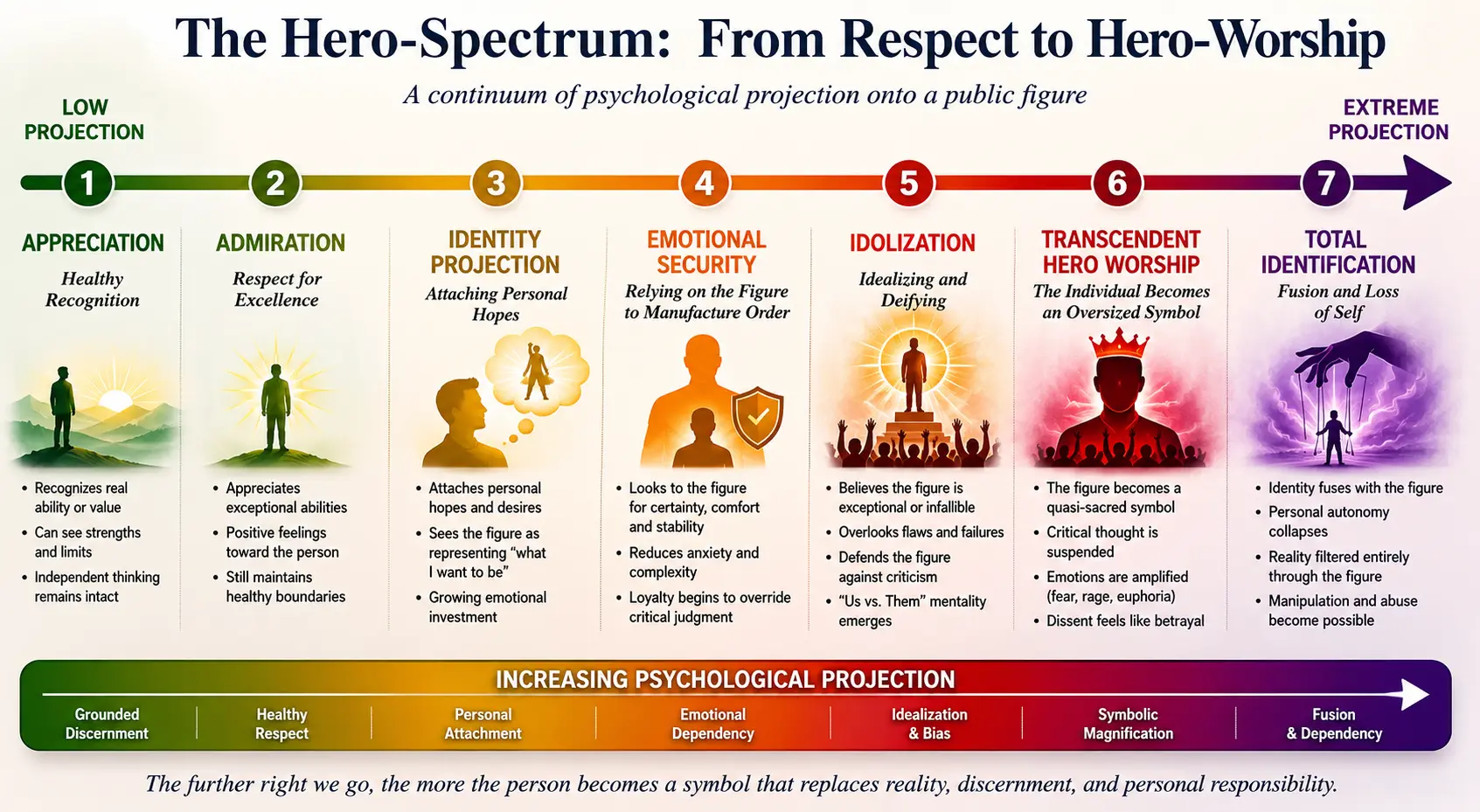
Thus, when admiration ceases to inspire real growth and instead evolves to dependency, the developmental function of heroism becomes distorted. Some of the destructive personality cults of the twentieth century may be understood as examples of this distortion, where the natural tendency to learn from exemplary figures was redirected into unquestioning devotion to charismatic leaders. Like scaffolding, heroes are not meant to be permanent fixtures but temporary supports that are removed when the structure is strong enough to stand on its own.
Human beings learn long before they can explain what they have learned. Children acquire language, social norms, values, and practical skills largely through observation and imitation rather than formal instruction. Psychologists have long recognized that much learning occurs through modeling; youth naturally look to parents, teachers, mentors, and other role models as guides for behavior. Philosophers such as Michael Polanyi observed that much of this knowledge is tacit in nature, acquired through participation and practice before it can be fully articulated.[ref] Children learn by following examples before they can fully articulate the principles involved; adults continue to look to respected or charismatic individuals who make visible qualities that might otherwise remain abstract ideals. Such figures therefore perform an important educational function. They demonstrate in practice the virtues, behaviors, and possibilities that others seek to cultivate within themselves.
Societies, as collections of individuals, exhibit similar developmental patterns. Before shared values become embedded within institutions and cultural norms, communities often depend heavily upon exceptional individuals to provide direction, cohesion, and vision. Founders, reformers, statesmen, prophets, and other exemplary figures frequently emerge during periods of social formation or crisis because they help solve problems of coordination and collective action.[ref] Their importance reflects a developmental necessity rather than a permanent requirement. Hero-centered leadership tends to arise naturally at certain stages of social development because it addresses real needs. Yet the long-term goal of healthy development is not perpetual dependence upon exceptional individuals but the gradual distribution of responsibility, initiative, and moral capacity throughout the wider community.
Heroes perform an important developmental function. They provide concrete examples of qualities that individuals and societies aspire to cultivate within themselves.
The emergence of heroes throughout history is not accidental. As human societies grow in size and complexity, they face increasingly difficult problems of coordination, trust, and collective action. Small groups can often function through informal relationships and shared understanding, but larger communities require visible sources of direction and cohesion. In times of uncertainty, conflict, or rapid change, exceptional individuals frequently emerge who possess unusual courage, wisdom, charisma, or organizational ability. Such figures often become focal points around which communities organize themselves. Heroes, therefore, arise not merely because people admire greatness, but because greatness can temporarily solve real social problems.
The narrative of Urantia's history in the Urantia Book revelation reveals that this pattern of hero-centered leadership was further accentuated by the disruptions caused by the planetary rebellion and the subsequent failure of Adam and Eve's mission.[ref] These events left humanity bereft of the intended superhuman leadership, such as the Planetary Prince and the Material Sons, which would have provided a stabilizing influence and advanced cultural and spiritual development.
In the absence of these divine leaders, humanity instinctively sought to fill the void by elevating human figures to heroic status, often attributing to them supernatural origins and miraculous deeds. This tendency reflects an innate longing for guidance "from above and beyond," a craving designed to anticipate the divine leadership that was lost due to rebellion. The legends of the Nephilim and the Adamites, for instance, illustrate how early humans mythologized their leaders, blending historical truths with imaginative narratives to create archetypes of heroism. These figures became focal points for societal organization and moral inspiration, embodying the qualities of courage, wisdom, and charisma that were essential for navigating the uncertainties of their time.
The selection of the eight leaders among the Four and Twenty Counselors as spiritual heroes underscores the enduring importance of such figures in the spiritual evolution of humanity. These leaders, chosen from among the early spiritual exemplars, represent the culmination of humanity's quest for moral and spiritual guidance. Their legacy highlights the role of heroes not only in addressing immediate social challenges but also in advancing the collective spiritual consciousness of their communities. Spiritual growth is reflective of social and individual progress.[ref] This developmental trajectory, shaped by both evolutionary necessity and the exigencies of rebellion, reveals the profound interconnectedness of human history and divine purpose.
To repeat, heroes perform an important developmental function. They provide concrete examples of qualities that individuals and societies aspire to cultivate within themselves. Courage becomes visible in the warrior, wisdom in the sage, conviction in the reformer, and service in the selfless leader. Children naturally learn through imitation, and societies often do the same. Heroes embody virtues that might otherwise remain abstract ideals. They inspire people to imagine possibilities beyond their present condition and help translate values into action. In this sense, heroes function as developmental scaffolding: temporary structures that support growth while individuals and communities acquire greater capacity for responsibility and self-direction.
The developmental value of heroes contains an inherent risk. What begins as inspiration can gradually become dependency.
The process can be observed in ordinary human development. A child initially depends upon a parent or guardian for protection, guidance, and decision-making. The parent/guardian serves as a kind of developmental hero whose greater experience and competence provide stability during the child's early years. Yet healthy parenting does not aim to preserve this dependency indefinitely. The parent's success is measured by the gradual transfer of responsibility to the child. The child learns to make decisions, exercise judgment, and assume accountability. If dependence persists indefinitely, development is hindered. What was once necessary support becomes an obstacle to maturity.
Difficulty arises when the developmental support becomes a permanent dependency. The purpose of scaffolding is not to remain forever attached to the building, but to support its construction until it can stand on its own. Likewise, healthy growth requires that responsibility gradually move from the exceptional few to the broader community. When responsibility, initiative, and moral courage become concentrated in heroic figures, the development of others can be inhibited. Individuals, communities, and societies cease growing when responsibilities that are themselves the means of growth are transferred to those perceived as uniquely qualified to bear them. What begins as admiration can gradually become dependency.
Viewed in this light, the problem we’ve identified as stunted growth arises coincident with heroes. It is not a problem of heroism itself. Heroes serve a necessary role at certain stages of personal and social development. The deeper question is whether humanity is meant to remain dependent upon heroes indefinitely. If the highest function of a hero is to awaken undeveloped capacities in others, then the measure of greatness may not be what the hero accomplishes personally, but what others become because of that hero's influence. We will see that this possibility points clearly directly to the gospel of Jesus, where the emphasis shifts from the elevation of heroic individuals toward the awakening of spiritual initiative within all persons.
When Heroes Become Indispensable
The developmental value of heroes contains an inherent risk. What begins as inspiration can gradually become dependency. The very qualities that make heroes useful—their courage, wisdom, strength, vision, or charisma can lead others to transfer responsibility to the hero. Instead of awakening similar capacities in the wider community, heroes can become the designated bearers of responsibilities that properly belong to everyone. The hero no longer serves as an example to emulate but becomes a substitute for personal growth and collective action.
As noted above, Max Weber argued that charismatic leaders emerge especially during periods of crisis and social instability because they appear capable of solving problems that ordinary institutions cannot. Followers attribute extraordinary qualities to such individuals and willingly surrender portions of their own judgment and initiative. He reasoned the strength of charisma is precisely that it mobilizes people. Its danger is that authority becomes centered in the leader rather than internalized within the community.[ref] Erich Fromm argued that people often flee the burdens of freedom and responsibility by attaching themselves to powerful leaders, institutions, or ideologies. The attraction of the leader is not simply admiration but relief from the anxiety of self-direction.[ref] And Carl Jung explains the hero archetype appears because individuals project unrealized aspects of themselves onto heroic figures. Healthy development eventually requires reclaiming those projected capacities and integrating them into one's own personality. According to Jung, the qualities admired in a hero should gradually become internalized as part of one's own character development rather than remaining permanently projected onto another person.[ref]
This tendency appears repeatedly throughout history. Military leaders become indispensable defenders. Political leaders become indispensable rulers. Religious leaders become indispensable mediators. Reformers become indispensable voices of conscience. In each case, genuine accomplishments often justify admiration. Yet admiration can quietly evolve into reliance. People begin to look to exceptional individuals to solve problems that ultimately require the participation and development of the broader community. The result is a concentration of responsibility in the few and a corresponding weakening of initiative among the many.
The problem is not merely political or social; it is also psychological. Heroes provide certainty in times of confusion and reassurance in times of fear. They simplify complexity by giving people someone to follow, trust, or imitate. Yet the longing for security can gradually eclipse the harder work of personal growth. It is often easier to admire courage than to become courageous, easier to praise wisdom than to cultivate wisdom, and easier to follow conviction than to develop conviction. Hero-dependence therefore reflects a subtle temptation to transfer the burdens of growth to others.
Religious history provides some of the clearest examples of this dynamic. Founders, prophets, saints, and spiritual teachers often begin by calling people to greater personal responsibility before God. Yet succeeding generations frequently transform these same figures into objects of dependence. What began as a path becomes a personality; what began as an invitation becomes a hierarchy of intermediaries. The focus shifts from the transformation of the believer to the exaltation of the exemplar. In such circumstances, reverence for greatness can unintentionally inhibit the very growth that greatness was meant to encourage.
Hero religion contains the same developmental tension found in other forms of heroism. What begins as inspiration can gradually become dependency.
The deeper issue is developmental. Human beings grow through the exercise of responsibility. Moral strength develops through moral decisions. Spiritual insight develops through personal faith and experience. Wisdom develops through participation in life's challenges. Whenever these responsibilities are permanently transferred to heroic figures, the opportunities for growth diminish. Individuals, communities, and even civilizations can become trapped in patterns of dependency that prevent the fuller development of their latent capacities.
Viewed in this light, the highest achievement of a hero may not be the performance of extraordinary deeds but the awakening of extraordinary possibilities in others. The greatest leader is not the one who remains indispensable, but the one who gradually makes his or her own indispensability unnecessary. This raises a profound question: Is humanity destined to remain dependent upon heroes, or is there a higher stage of development in which the qualities once concentrated in a few become distributed throughout the many? It is precisely this question that brings us to the gospel of the kingdom proclaimed by Jesus.
Hero Religion
The tendency to elevate heroic figures is not confined to politics, warfare, or culture; it appears just as prominently in religion. Throughout history, human beings have often organized their spiritual lives around exceptional individuals who seem to possess unusual access to divine reality. Kings ruled by divine mandate. Prophets spoke on behalf of God. Priests mediated between the sacred and the ordinary. Shamans traversed unseen worlds. Saints embodied spiritual ideals. Messiahs promised deliverance. In each case, the hero served as a focal point through which a community sought guidance, meaning, and connection with powers greater than itself.
Such figures arose for understandable reasons. Religion concerns ultimate questions that often transcend ordinary experience. Most people do not claim visions, revelations, or extraordinary spiritual insight. Faced with uncertainty regarding the nature of God, the meaning of life, or the demands of morality, communities naturally look to those who appear to possess greater wisdom or spiritual attainment. Heroic religious figures help people navigate the uncertainties of existence by offering meaning, direction, and a framework for understanding reality. Such figures help people understand their place in a larger spiritual reality and provide direction amid questions that transcend ordinary experience. They offer visible examples of faith and become centers around which communities can organize belief and practice. In this context, I’m calling this form of religion “hero religion.”
That said, hero religion contains the same developmental tension found in other forms of heroism. What begins as inspiration can gradually become dependency. Spiritual authority becomes concentrated in a small number of exceptional individuals while the larger community assumes a more passive role. The shaman intercedes the spirit world for material solutions. The king governs God's people. The prophet speaks for God. The priest interprets God's will. The saint exemplifies holiness. The messiah accomplishes salvation. The many receive what the few provide. Responsibility becomes centralized rather than distributed.
This arrangement can provide stability and direction, particularly during the formative stages of a society’s religious development. Like other forms of scaffolding, it may serve a legitimate purpose for a time. But it also carries a hidden cost. Human beings develop through participation. Moral strength grows through moral decisions. Spiritual insight grows through personal faith and experience. Wisdom grows through the exercise of judgment. When these responsibilities are permanently transferred to spiritual specialists, opportunities for growth are typically restricted. The very structures that once supported development can eventually inhibit it.
The appeal of hero religion is therefore understandable. It offers certainty in the face of mystery and simplicity in the face of complexity. It relieves individuals of some of the burdens associated with spiritual discernment and responsibility. It is often easier to seek answers from a spiritual authority than to wrestle personally with questions of truth, faith, and service. Yet this same attraction can encourage dependence. The devotee becomes a follower of personalities rather than an active participant in spiritual growth.
Jesus consistently redirected attention away from himself and toward the Father. While fully aware of his unique mission, he did not cultivate dependence upon his personality.
If this analysis is correct, then I submit that hero religion represents just one stage within religious development. The deeper question becomes whether the purpose of the prophet is merely to have followers or to awaken prophetic insight in others; whether the purpose of the teacher is merely to instruct or to cultivate teachers; whether the purpose of the spiritual hero is to gather admirers or to help others discover their own relationship with God.
It is precisely at this point that Jesus appears to depart from many traditional patterns of religious heroism. While he became one of history's most admired figures, his gospel consistently redirected attention away from dependence upon personalities and toward the direct relationship between every individual and the Father. Again and again, he emphasized personal spiritual experience, individual responsibility, and participation in the work of the kingdom. To understand the revolutionary nature of this shift, we must now examine how Jesus transformed the meaning of greatness, authority, and heroism itself.
Part II — Jesus and the Transformation of Heroism
The Hero Who Refused Hero Status
If hero cultures naturally seek exceptional individuals upon whom to concentrate authority, responsibility, and hope, then Jesus presents an intriguing paradox. Few figures in history have inspired greater admiration, loyalty, or devotion. Yet throughout his life he repeatedly resisted efforts to make him the kind of hero people expected. He did not deny his mission, nor did he shrink from leadership. Rather, he consistently redirected attention away from the personality-centered forms of heroism that characterized much of human history and toward a deeper spiritual reality centered in the Father and the kingdom of heaven.
The expectations placed upon Jesus were immense. Many of his contemporaries longed for a political deliverer who would liberate Israel, restore national greatness, and fulfill popular expectations concerning the Messiah. Others sought miraculous demonstrations, hoping he would provide undeniable proof of divine authority. Still others looked to him as a teacher who could settle every dispute and answer every question. The impulse was familiar. Like countless societies before them, people sought a heroic figure who could carry burdens they felt unable to bear themselves.
Jesus repeatedly disappointed these expectations. He refused political kingship when the crowds sought to make him king. He declined to organize a political movement. He resisted attempts to define his mission in nationalistic or military terms. Even when confronted by sincere followers, he often challenged their assumptions about greatness, power, and authority. The kingdom he proclaimed was not established through coercion, conquest, or personal domination. It was built through inner transformation and voluntary participation in the Father's will.
This pattern extended beyond politics. Jesus consistently redirected attention away from himself and toward the Father. While fully aware of his unique mission, he did not cultivate dependence upon his personality. He taught his followers to pray, "Our Father," not "My Father." He emphasized the individual's direct relationship with God and repeatedly encouraged personal spiritual experience. His message was not that people should attach themselves more firmly to him as a personality, but that they should discover for themselves the living reality of sonship with God.
His approach to leadership reflected the same principle. The rulers of the world exercised authority from above, but Jesus taught that greatness in the kingdom was measured by service. The greatest was to become the servant of all. Leadership was not a privilege that elevated one person above others; it was a responsibility undertaken for their benefit. Rather than gathering power toward himself, Jesus continually invested himself in the development of others. He trained apostles, commissioned evangelists, sent out teachers, and entrusted responsibility to ordinary men and women. His ministry consistently pointed beyond admiration toward participation.
This distinction is crucial. The problem identified in Part I was never heroism itself. Courage, wisdom, service, and spiritual greatness remain worthy of admiration. The problem arises when admiration evolves into dependency and the capacities embodied by the hero remain permanently concentrated in the few. Jesus appears to have understood this danger. Rather than encouraging people to remain spectators of greatness, he sought to awaken greatness within them. Rather than becoming indispensable, he prepared others to assume responsibility for the work of the kingdom.
In this sense, Jesus may represent a profound transformation of the hero archetype. He did not abolish heroism; he redefined its purpose. The highest hero is not the one who gathers the largest number of followers, but the one who most effectively awakens courage, faith, wisdom, and spiritual initiative in others. His greatness lay not merely in what he accomplished personally, but in what he enabled others to become. The hero had come not to create admirers, but to create fellow workers in the Father's vineyard.
Flavius and the Priceless Treasures
Jesus didn’t come right out and use the word “heroism.” Neither the biblical accounts nor the Urantia Book do either. Nevertheless, Jesus did indirectly teach the transformation of heroism. It can be seen not only in his treatment of power and authority but also in his treatment of admiration itself. A revealing example appears during his visit to the home of Flavius, a wealthy Greek believer who delighted in showing visitors the rare and beautiful treasures he had collected during his travels.[ref] Concerned that Jesus might disapprove of such possessions, Flavius carefully explained their history and significance. Yet Jesus showed no sign of offense. Rather than condemning the collection, he displayed a friendly interest in the objects and the genuine appreciation their owner felt toward them.
The response is noteworthy because it differs from how many Jewish religious teachers of the time might have approached Flavius's collection. Since the days of Moses, Israel's religious tradition had repeatedly warned against idolatry and the worship of "graven images."[ref] The concern was understandable: people often transferred reverence that properly belonged to God onto visible objects, symbols, or artifacts. The common remedy was prohibition—do not bow before this image, do not venerate that object, do not allow created things to displace the Creator.
Yet Jesus took a different path. He neither attacked the treasures nor criticized Flavius for taking pleasure in them. Instead, he redirected the discussion toward what he described as the "supreme duty" of human life.[ref] The coming kingdom, he explained, would not be characterized primarily by endless prohibitions—"Do not worship this" or "Do not worship that"—but by a positive orientation toward the worship of God and the loving service of one's fellows.
What may seem remarkable about the Urantia Book's depiction of this encounter, is that one section above the story of Flavius (at 142:3) Jesus is answering the apostles questions about growth of the concept of God in the Jewish minds of previous generations. Jesus points back to the writings of Isaiah found in chapters 40 to 55 of the Book of Isaiah, which reflects this spiritual evolution. Jesus teaches that Isaiah declared a God who was not only the deity of Israel but the God of all nations, emphasizing themes of forgiveness, redemption, and the enduring love of God for humanity. The reference to the "greater spiritual enlightenment of Isaiah’s day," where the "ten negative commandments were changed into the great and positive law of love," aligns with the transformative teachings attributed to Isaiah, particularly the second Isaiah, during the Babylonian captivity. This period marked a profound shift in the understanding of divine law and the nature of God. Isaiah's teachings emphasize a universal God of love, righteousness, and mercy, moving beyond the earlier, more prohibitive and fear-based commandments. He proclaimed a God who desired justice, compassion, and a personal relationship with humanity, encapsulated in the call to "love God supremely and your neighbor as yourself".
The hero syndrome is fundamentally about locating spiritual power, responsibility, and moral agency outside oneself—in heroes, kings, priests, saviors, idols, institutions, or exceptional personalities. The progression Jesus describes in 142:3 is moving in the opposite direction. The God of Isaiah is becoming less tribal, less external, less dependent on intermediaries, and more universally accessible. As God becomes the loving Father of all humanity, the individual stands in a more direct relationship with the divine.
This shift that the midwayer's modernization of Jesus' teachings here has implications beyond the question of idols and images. As religious consciousness evolved, spiritual authority was gradually relocated from external objects, rituals, and personalities toward the individual's living relationship with God. The gospel of the kingdom transforms the prohibition against graven images into the positive law of love. As in Isaiah it also undermined the tendency to place ultimate trust in earthly intermediaries. In this light, the kingdom gospel points beyond both idol worship and personality worship. Its aim is not merely to redirect devotion from one object to another, but to awaken each individual to a direct and personal participation in the Father's will.
This distinction bears directly upon the problem of heroism. The solution to pathological hero worship is not the elimination of admiration. Human beings naturally admire excellence, beauty, courage, wisdom, and greatness. Such admiration often serves an important developmental function. The deeper question is what admiration ultimately accomplishes. Does it awaken growth, responsibility, and service, or does it terminate in the object being admired? Does it inspire participation or merely observation? Does it enlarge the individual or foster dependency?
What we're really saying is that Jesus' response to Flavius was not an isolated teaching. It was part of a long religious trajectory moving from: prohibition → aspiration fear → love external regulation → internal transformation negative commandments → positive spiritual purpose That is exactly the trajectory that should begin to reduce the psychological reliance on hero-centered religion. Jesus is teaching through the gospel how one can move to spiritual maturity just by changing one's approach to the Father.
Jesus as the Great Multiplier
Instead of merely arguing that Jesus opposed dependency, it is possible to observe that nearly every major feature of his ministry was designed to multiply spiritual agency in others. This perspective reveals an often-overlooked dimension of the gospel. Jesus did not simply teach truth; he systematically empowered others to live, share, and embody it for themselves. The pattern appears so consistently throughout his life that it may be understood as one of the defining characteristics of his ministry.
The title "Jesus as the Great Multiplier" stands in sharp contrast to the conventional hero model. Heroes accumulate followers. Multipliers create more actors. Heroes gather attention toward themselves. Multipliers awaken capacities within others. If the purpose of the kingdom had been to establish a permanent dependence upon a central heroic figure, Jesus' methods seem strangely counterproductive. Again and again he dispersed responsibility, encouraged initiative, and entrusted ordinary men and women with increasingly significant roles in the work of the kingdom.
This pattern first becomes evident in his training of the apostles. Jesus did not select scholars, priests, rulers, or military leaders. He chose ordinary individuals and then devoted years to developing their capacities. He taught them, challenged them, corrected them, and gradually entrusted them with greater responsibility. Their role was never intended to be passive. They were being prepared not merely to follow a leader but to become leaders themselves. The measure of Jesus' success was not how many people depended upon him, but how many learned to cooperate with the Father's will as he did.
One of the clearest examples of Jesus' multiplying approach to leadership appears in the ordination and commissioning of seventy evangelists to preach in the surrounding areas. Significantly, these were not members of the apostolic corps. Having already trained and commissioned the twelve, Jesus might have concentrated all responsibility in this inner circle. Instead, he expanded the circle of participation. He selected seventy additional disciples, ordained them, and sent them forth in pairs to proclaim the gospel of the kingdom throughout Galilee, Samaria, and Judea.
This decision reveals an important feature of Jesus' ministry. The kingdom was never intended to depend upon a small spiritual elite. Responsibility was continually being distributed rather than centralized. The seventy were entrusted with the same essential mission as the apostles: to preach the good news, minister to the sick, and represent the Father's love to others. In sending them forth, Jesus demonstrated confidence in the spiritual capacities of ordinary believers and affirmed that participation in the kingdom was not reserved for a privileged few.
The sending of the seventy reveals this multiplying principle on an even larger scale. Significantly, these were not members of the apostolic corps. They represented a broader circle of disciples who were likewise commissioned to carry the message of the kingdom. Here the movement expands beyond a select group and begins to demonstrate its true character. Authority and responsibility are not concentrated but distributed. The kingdom grows not through the accumulation of followers around a central figure but through the continual empowerment of new participants. One becomes twelve, twelve become seventy, and seventy become hundreds. The trajectory is outward rather than inward, expansive rather than centralized.
Viewed through the lens of universal heroism, the sending of the seventy marks a decisive step away from the traditional hero model. A hero-centered movement gathers authority toward the center; Jesus repeatedly pushed authority outward. Rather than creating a growing body of dependent followers, he created an expanding community of active participants. The progression from the twelve to the seventy reveals a deliberate strategy of multiplication in which leadership, service, and spiritual responsibility were continually shared with others. The kingdom advanced not through concentration but through diffusion, not through dependence but through empowerment.
This process reaches a profound climax in Jesus' promise of the Spirit of Truth. Throughout history, religious systems have often depended upon intermediaries who claim unique access to divine guidance. The Spirit of Truth radically alters that relationship. No longer is spiritual insight confined to a select class, institution, or hierarchy. The spirit ministry of Jesus becomes universally available to all believers. What had once been concentrated becomes distributed. What had once required proximity to a teacher becomes accessible through personal spiritual experience. The Spirit of Truth may therefore be understood as the ultimate instrument of spiritual multiplication, extending the living presence and guidance of Jesus to every individual.
Communities preserve memory; movements advance purpose.
The same principle is reflected in Jesus' teachings about the Father. Again and again, he directed attention beyond himself toward the universal Father and emphasized the direct relationship available to every child of God. This was one of the most revolutionary aspects of his gospel. The kingdom did not require privileged access through priests, rulers, heroes, or even apostles. Every individual could approach the Father personally through faith. Every individual could become a participant in the divine family and a coworker in the realization of the kingdom on earth.
Viewed from this perspective, the gospel reveals a remarkable consistency. Jesus trained followers to become leaders, expanded responsibility beyond the apostolic circle, promised a universal Spirit of Truth, and proclaimed direct access to God. At every stage, the movement is away from concentration and toward multiplication. The kingdom does not culminate in a single hero standing above humanity. It culminates in countless sons and daughters of God discovering their own capacity to participate in the Father's work. In this sense, Jesus was not merely the greatest hero. He was the greatest multiplier of human spiritual potential the world has ever known.
Epilogue
Continuing the Trajectory
The challenge before the last three-quarters of the 21st century is more than the preservation of a revelation. It is the continuation of the progressive trajectory of God's self-disclosure[ref] and humanity's participation in the Father's unfolding purpose.
Religious history reveals a remarkable pattern, albeit a trajectory of progressive disclosure and understanding. At pivotal moments, new spiritual insight has not discarded what came before but enlarged it. The prophets expanded humanity's understanding of a unexceedable Deity beyond tribal identity toward a universal Father whose righteousness was expressed initially by austerity and then through justice, mercy, and love. Jesus embraced that trajectory and carried it further. He did not merely proclaim a more accurate theology; he announced it as the gospel of the kingdom, inviting ordinary men and women into a direct relationship with the Father and an active partnership in the transformation of the world. Each stage did more than preserve the past. Each widened humanity's horizon and invited greater participation in the divine purpose.
The gospel of the kingdom was, and is, itself an invitation into unfinished work. Jesus did not present the kingdom as a completed achievement but as a living and growing reality. He compared it to seed planted in fertile soil, to leaven it by working through the whole loaf, and to a harvest awaiting laborers.[ref] The kingdom was not simply to be believed; it was to be lived, extended, and embodied. Its progress depended not upon the appearance of another heroic figure but upon the willingness of countless individuals to cooperate with the Father's will in the ordinary circumstances of daily life.
The larger cosmological vision of the Fifth Epochal Revelation extends this trajectory still further. Humanity's participation in the kingdom is revealed to be part of a much broader evolutionary enterprise. Personal spiritual growth, social progress, and the realization of the brotherhood of humanity are no longer seen as isolated religious ideals but as contributions to an unfolding universe whose destiny is bound up with the experiential growth of the Supreme. The stage grows larger, but the invitation remains remarkably familiar: to know the Father, to love one's fellows, and to participate consciously in the divine adventure of creation.
I have written elswhere in the essay Restating the Gospel in an Age That No Longer Speaks Its Language, that cultural context demands adaptation in the vernacular of the generation it is being recasted. For example, the parable of the sower might be restated as the process of launching a new app or platform. The app is introduced to various markets (the soils), and its success depends on the receptivity of the users. Some markets might reject it outright (the rocky soil), others might adopt it briefly but lose interest (the shallow soil), while others might embrace it fully, allowing it to flourish and create meaningful change (the fertile soil). This modern analogy captures the idea that spiritual truths, like innovative ideas, require the right conditions and receptivity to thrive.
Seen in this light, the question before the modern world is not whether another revelation should be preserved, nor whether another religious hero should arise. The more compelling question is whether humanity will continue the trajectory already set in motion. Can each generation enlarge its understanding of God, deepen its experience of sonship, broaden the practice of brotherhood, and assume greater responsibility for the realization of the kingdom than the generation before it? Progressive revelation suggests that this is precisely what history expects of us.
This perspective also casts the role of spiritual movements in a different light. Their highest purpose is not merely to preserve teachings, defend institutions, or cultivate communities—essential as those tasks may be. Their greater calling is to awaken participation in an unfinished enterprise. Communities preserve memory; movements advance purpose. A living movement reminds each generation that revelation is not only something to study but something to embody, extend, and translate into the language and needs of its own time.
The Urantia movement stands at an unusual moment in religious history. It has largely avoided many of the dangers associated with personality cults and institutional authoritarianism. It possesses no central charismatic leader, encourages individual study, and consistently points beyond human personalities toward the Universal Father. These are remarkable strengths. Yet every movement faces its own characteristic temptation. Having been entrusted with an extraordinary revelation, it can become more concerned with preserving its language than extending its meaning.
The challenge before the movement now a century after publication, is similar to the one that the apostles were faced with. It is incumbent upon those that want to live the revelation to not simply repeat the revelation faithfully but to continue its own developmental trajectory. Every generation must discover how to translate eternal realities into the conceptual language of its own age. Terms such as soul, personality, Thought Adjuster, the Supreme, the Ultimate, and Paradise describe realities of immense depth, yet their symbolic power is not self-evident to modern ears. If the Fifth Epochal Revelation is to engender a living movement rather than an inherited vocabulary, these concepts must continually be interpreted, illustrated, and embodied in ways that awaken experience rather than merely transmit information. Therefore, the task of the Urantia movement is not merely to preserve an epochal revelation, but to employ that revelation in advancing the same kingdom movement Jesus inaugurated. The revelation is a gift; the movement is its purpose.
This is what I mean to restate the gospel in an age that no longer speaks its language. The gospel itself becomes the story that calls forth heroism in everyone. It does not abolish admiration, but redirects it. It does not diminish greatness, but multiplies it. It does not gather spiritual authority into the hands of a select few, but progressively distributes responsibility throughout the entire family of God.
Tina Turner's refrain, "We don't need another hero," therefore carries an irony that few have recognized. The gospel of the kingdom agrees—but for a profoundly different reason. Its purpose is not to end heroism but to transform it. The greatest triumph of the hero is not that (s)he remains forever at the center of history, but that one awakens in others the courage, wisdom, faith, and love to continue the Father's disclosure. In the end, the story has never been about finding another hero. It has always been about enlarging the circle of those who willingly participate in the eternal adventure of building the kingdom of heaven on earth.
// Bob Debold June 2026.