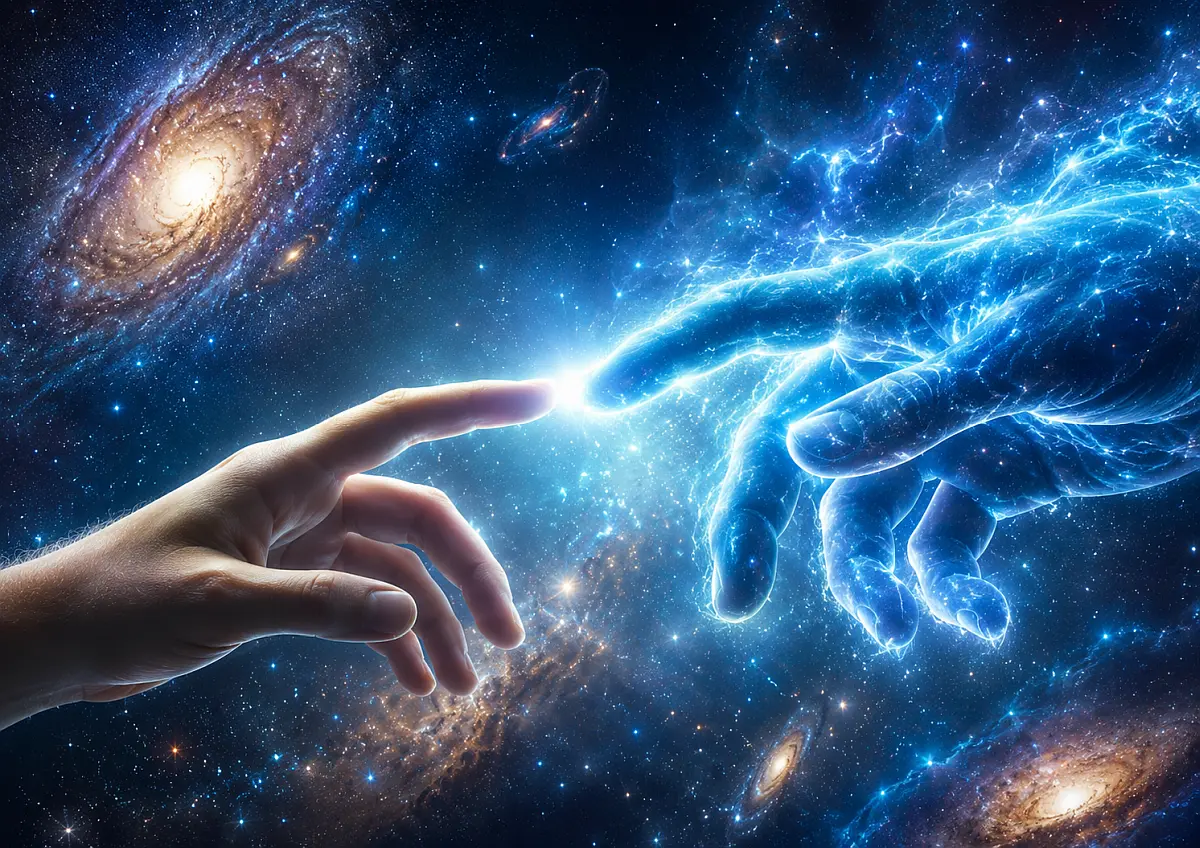
—Pierre Teilhard de Chardin, Christianity and Evolution
Cosmic Creation by Delegation
From Infinite Origins to Finite Planetary Destiny
Abstract
The Urantia Book presents creation not as a single divine act completed in the distant past, but as a progressive process in which divine purpose is expressed through delegated agency, natural law, evolutionary development, and creature participation. This essay traces that pattern from the Infinite origins of reality through the organization of the universes and ultimately to the successive ministries guiding the development of inhabited worlds. Particular attention is given to Adam and Eve, not as the first human beings, but as Material Sons whose biological and cultural mission represents one stage within a much larger planetary progression. Their story also provides an opportunity to reconsider intriguing genetic findings concerning human introgression near the period assigned by the revelation to the Adamic mission. More broadly, the essay argues that scientific explanations of natural process need not exclude higher levels of organization, agency, or purpose. In this cosmology, God does not accomplish creation alone; creation unfolds through an increasingly coordinated universe of participating beings.
How to Read This Essay
An Invitation to the Reader
This essay is intentionally ambitious. It brings several lines of inquiry together around one central question. Rather than presenting a single argument, it integrates several lines of study. This includes a simplification made to accommodate human cognitive limits regarding God’s infinity: the I AM. The essay’s primary question it attempts to answer is: How can divine purpose operate through natural processes and delegated agencies without diminishing either God’s sovereignty or the genuine causality of creation?
At approximately 7,000 words, this is not a quick read, and the accompanying podcast is not intended simply as background listening. Both reward sustained attention. Readers who prefer a more intuitive or artistic entry point may begin with the song, while the slide presentation offers a concise visual overview of the argument.
It may help to read the essay as a progression: from the organization of cosmic reality, through delegated celestial administration, to planetary evolution and finally to biological process.
- Read deliberately rather than quickly.
- As you move through the sections, keep asking how each level, from cosmic organization to biological evolution, expresses the principle of delegation.
- If an idea doesn't immediately resonate, continue reading before deciding. Later sections often illuminate earlier ones.
- You need not agree with every conclusion to benefit from the exploration. The goal is not merely to persuade but to invite fresh consideration of familiar ideas.
- If listening to the podcast, consider following along with the transcript or listening in shorter segments.
Above all, ask yourself one question as you read: Can divine purpose work through natural processes and delegated beings without replacing the genuine activity of either?
Whether or not you agree with the conclusions, that question lies at the heart of everything that follows.
Explore the essay through audio via a podcast (24 mins.)
Engage with a musical rendition (6:19 mins:secs.)
See the ideas take shape (15 slides)
Introduction: Divine Causation, Evolutionary Development, Adam and Eve, and the Long Ascent Toward Perfection
uman beings have always told stories about beginnings. Ancient creation accounts differ in their gods, materials, and imagery, but most attempt to answer the same questions: Where did the world come from? How did human beings appear? And what relationship, if any, exists between humanity and the divine?
In one Chinese tradition, the goddess Nüwa fashions human beings from clay.[ref] In Greek and Roman mythology, Prometheus molds humanity from earth and water.[ref] Egyptian stories portray the god Khnum forming people upon a potter’s wheel.[ref] Genesis describes God forming Adam from the dust of the ground and breathing life into him.[ref]
These stories preserve a common intuition: humanity is not merely an accidental arrangement of matter. There is something about human existence that points beyond the visible components from which we are made. In all the cases just referenced, it is a someone—a personality if you will who acts as an agent.
Modern science approaches the question differently. Cosmology investigates the evolution of the physical universe. Geology reconstructs the formation of the earth. Evolutionary biology traces the emergence and diversification of life. Genetics discloses the long history recorded within living organisms.
These sciences have transformed what humanity knows about its origins. But scientific explanations do not necessarily answer the metaphysical questions that creation stories attempted to address. A description of how matter changed over time does not by itself explain why reality exists, why it possesses its particular forms of order, or how physical processes eventually became capable of life, mind, moral choice, and spiritual aspiration.
The Urantia Book (UB) offers a distinctly integrative way of coordinating these two approaches. It does not ask readers to choose between instantaneous divine construction and purposeless material evolution. Instead, it portrays creation as a vast, layered process in which divine purpose becomes progressively expressed through an ordered succession of personalities, agencies, laws, and evolving systems.
It originates this thinking in the exquisite depiction of the Universal Father that harmonizes the various beliefs related to how God interacts with the Universe. The revelation bridges the truths in Theism, Deism, Occasionalism, and Panentheism. In fact, God is presented as the origin of reality, the upholder of reality, but not as a solitary cosmic artisan personally performing every subsequent act of creation. This passage is significant:
4:1.6 (55.4) The Universal Father has not withdrawn from the management of the universes; he is not an inactive Deity. If God should retire as the present upholder of all creation, there would immediately occur a universal collapse. Except for God, there would be no such thing as reality. At this very moment, as during the remote ages of the past and in the eternal future, God continues to uphold. The divine reach extends around the circle of eternity. The universe is not wound up like a clock to run just so long and then cease to function; all things are constantly being renewed. The Father unceasingly pours forth energy, light, and life. The work of God is literal as well as spiritual. “He stretches out the north over the empty space and hangs the earth upon nothing.”
Put simply, this essay advances one central proposition: God creates through delegation. Natural laws possess genuine efficacy. Evolutionary processes do real work. Creatures exercise real agency. Celestial personalities perform real ministries. Yet all remain grounded in and coordinated with the ultimate source of reality.
The passage at 4:1.6 gathers a truth emphasized by each of the five worldviews considered here: with theism, it affirms God as the originating and sustaining source of reality; with deism, it recognizes a universe endowed with stable laws and genuine secondary causes; with pantheism, it acknowledges that all reality is grounded in and permeated by the divine, though not identical with God; with atheistic naturalism, it accepts the integrity and explanatory power of natural processes within their proper domain; and with panentheism, it portrays the universe as existing within the encompassing presence of God while God infinitely exceeds it. At the same time, it diverges sharply from occasionalism by affirming that created beings, natural processes, and delegated agencies exercise genuine causal powers rather than serving merely as occasions for God’s direct action.[ref]
To understand the nuances, let’s explore how this teaching aligns with, and differs from, these philosophical and theological frameworks.[ref]
In classical theism, God is often understood as the creator and sustainer of the universe, a being who is both transcendent and immanent. The passage aligns with this view in its assertion that the Universal Father is the upholder of all creation, actively involved in the ongoing renewal of the cosmos. It emphasizes that God’s work is both literal and spiritual, suggesting a dynamic relationship between the divine and the material universe. This resonates with theistic ideas of divine providence, where God not only initiates creation but also continuously sustains and governs it. However, the passage goes further by describing this divine activity as an unceasing outpouring of energy, light, and life, which is more detailed and specific than many traditional theistic descriptions.
Deism captures an important truth in its recognition that creation possesses genuine order, regularity, and causal integrity. The universe is not depicted as requiring continuous supernatural interruption in order to function. Natural laws, evolutionary processes, and created agencies possess real capacities of their own. The Urantia cosmology departs from deism, however, in rejecting the idea of a Creator who establishes the universe and then withdraws. The Father remains the continuous source and upholder of reality, while divine purposes are carried forward through an extensive hierarchy of delegated agencies.
Pantheism and panentheism each preserve another aspect of the relationship between God and creation. Pantheism emphasizes the profound dependence of all reality upon the divine and resists imagining God as merely one being among others, but The Urantia Book does not identify God with the universe; Creator and creation remain distinguishable. Panentheism comes closer by holding that the universe exists within the encompassing divine reality while God nevertheless exceeds it. The Urantia depiction similarly combines transcendence and immanence, although its differentiation of the Seven Absolutes, Paradise, Deity, and finite creation is considerably more articulated than the panentheistic model.
Atheistic naturalism, although rejecting any divine source, nevertheless preserves a truth that the revelatory model also requires: natural processes must be allowed genuine explanatory power within the physical domain. Evolution, genetics, gravity, chemistry, and biological development are not illusions masking continuous supernatural intervention. Where the two perspectives part company is over whether those processes exhaust reality. The Urantia cosmology accepts their integrity while placing them within a larger architecture of mind, personality, purpose, and spiritual causation.
Occasionalism stands at the opposite causal extreme. It holds that created things possess no genuine causal efficacy and that God directly causes every event. The Urantia model rejects this as decisively as it rejects deistic withdrawal. Created personalities, natural systems, and celestial agencies possess authentic capacities and exercise genuine agency within the order God originates and sustains.
The passage at 4:1.6 (55.4) highlights the unceasing and harmonious relationship between God and creation, portraying the divine as both the foundation of all reality and the active sustainer of the universe. It presents creation as neither independent of God nor passive before him, but as a functioning order whose structure, renewal, growth, and evolution unfold within divine sustenance.
Reality is presented as relational and organized from its very infinite foundation.
In essence, this teaching offers a vision of God’s relationship with the universe that is both intimate and expansive, transcending the limitations of human philosophical constructs. It invites us to see the divine not as a distant or intermittent force but as the eternal source of all that is, actively engaged in the unfolding of creation.
God creates through delegation. And he delegates just about everything save Thought Adjusters and Personality.
And creation, in this enlarged sense, does not end with the appearance of matter, life, or humanity. It continues as an unfolding ministry through which evolutionary worlds are progressively guided toward biological stability, intellectual maturity, spiritual enlightenment, and eventual settlement in light and life.
Beyond the Image of a Solitary Creator
Traditional creation stories often compress divine causation into a single direct action: God speaks, commands, molds, or otherwise brings the world immediately into existence.
This imagery was understandable and perhaps unavoidable when human beings possessed little knowledge of cosmic scale, biological development, or the enormous spans of time involved in planetary evolution. But it also created a conceptual problem. If God directly performs every act, what meaningful role remains for natural law, evolutionary process, creature freewill participation, or the countless intermediate agencies suggested by an immense and organized universe?
The opposite response has been to remove divine purpose altogether. And essentially this is what the scientific revolution did. In a strictly materialist interpretation, the universe requires no source beyond its physical constituents. Matter, energy, law, life, consciousness, and personality must ultimately be explained within one uninterrupted material process.
Thus, the physical sciences do not require anything metaphysical. The scientific study of the early universe describes the development of observable physical conditions; it does not establish why there is a universe, why its laws are intelligible, or why it contains the potential for life and mind. Science can remain methodologically focused upon physical causes without claiming that physical causation exhausts all levels of reality.
The Universal Father is the First Source and Center of all things and beings, yet the Father does not act alone. Divine creativity is distributed through the Eternal Son, the Infinite Spirit, Paradise, the Absolutes, the Creator Sons, the Life Carriers, the universe power directors, and an almost immeasurable hierarchy of celestial personalities. We are taught free will can be a first cause.
Creation is therefore neither a create-and-leave mechanism nor the product of continuous divine micromanagement. It is an administered and participatory universe.
From the I AM to the Seven Absolutes
Before introducing, for some, either new or abstruse terminology, it helps to see the problem the revelation is attempting to describe. How can an infinite reality be the source both of what already exists and of everything that may yet become? How can personality, spirit, mind, energy, matter, actuality, and possibility remain differentiated while belonging to one reality?
The cosmology of The Urantia Book begins beyond space, time, matter, and finite personality. It asks the human mind to consider infinity before any finite universe, creature, or event can be imagined.
The papers employ the philosophical symbol of the I AM to describe undifferentiated infinity before reality can be meaningfully distinguished as personal or impersonal, actual or potential, spiritual or material. This is not presented as a historical event occurring at some remote moment in time. Time does not yet exist in such a conception. Rather, the papers translate relationships of eternity into a sequence that finite minds can partially comprehend.
Paper 105 Deity and Reality describes this conceptual beginning as the self-differentiation of the Infinite One from the Infinitude. From the standpoint of finite understanding, infinity becomes distinguishable in Seven Absolutes:
- the Universal Father - original personality and volitional source, the destiny of personality;
- the Eternal Son - the absolute personality, the secret of spiritual energy;
- the Infinite Spirit - universal ministry of mind and action;
- the Isle of Paradise - absolute pattern and source of material reality;
- the Deity Absolute - infinite reservoir of divine potential, encompassing all causational and personal possibilities within universal reality;
- the Unqualified Absolute - the boundless foundation of all nonpersonal and nondivine realities, embodying the ultimate potential of the impersonal cosmos; and
- the Universal Absolute - harmonizes all tensions between the infinite and the finite, the absolute and the relative, ensuring cosmic balance and unity.
These distinctions do not mean that infinity was physically divided into separate pieces. They describe foundational relationships within total reality. The revelation expands upon this with a concept called the triunities which is beyond the scope of this essay.
The Universal Father is the original personality and volitional source. The Eternal Son is the absolute expression of divine spirit personality. The Infinite Spirit becomes the universal minister of mind and action. Paradise is the absolute pattern and source of material reality. The Deity and Unqualified Absolutes contain the potentials of future personal and impersonal reality, while the Universal Absolute coordinates the tensions between them.
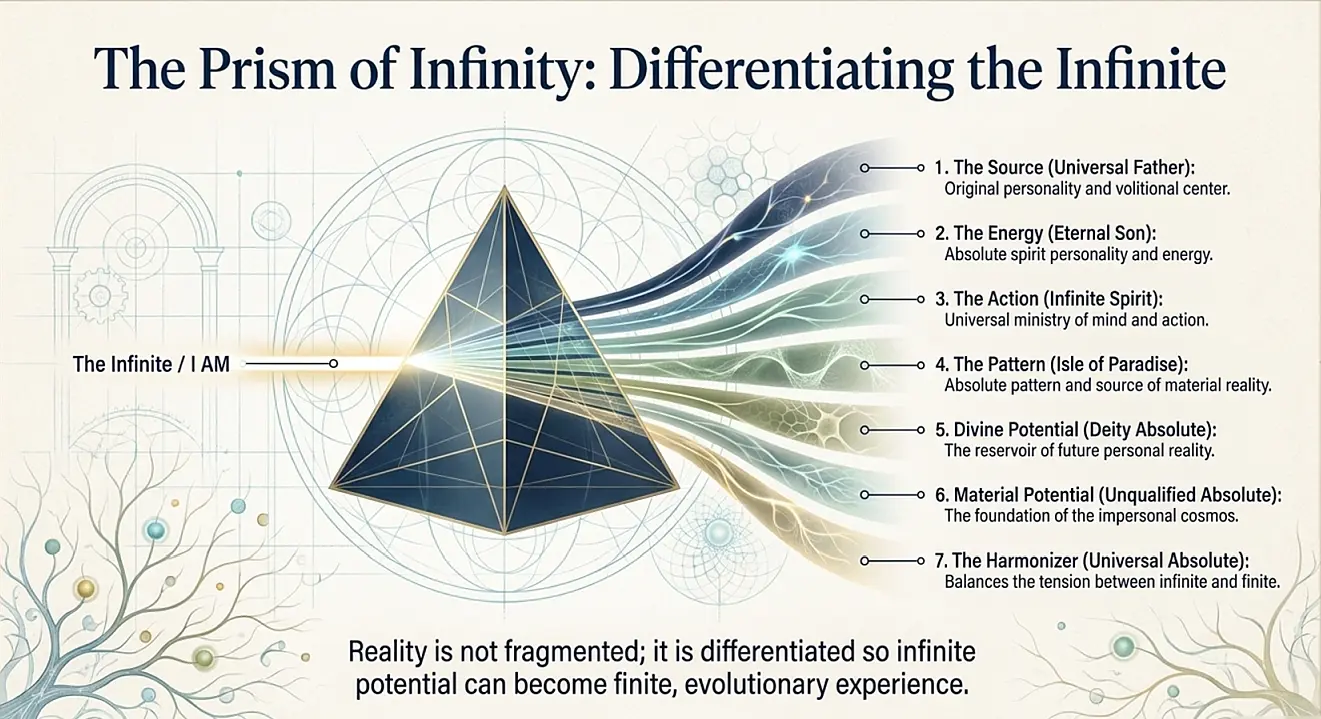
The important point is not merely the number seven. The greater insight is that reality is presented as relational and organized from its very infinite foundation.
Six of the seven Absolutes are interestingly partitioned as potential and actual with the Father as the ultimate source of all. At the most fundamental level of reality, potentiality and actuality are coordinated. One of the most striking aspects of this coordination is its progressive nature. Potentiality is not actualized all at once but unfolds over time, allowing for the evolutionary growth of the cosmos and the experiential participation of personal beings. This process is evident in the gradual development of the physical universe, the emergence of life on a planet, the growth of mind and spirit when the adjutants arrive, and the ultimate realization of divine values such as truth, beauty, and goodness when humans appear. Each step in this progression represents the transformation of potential into actuality, guided by the overarching purpose of the divine plan.
The Urantia Book portrays the Universal Father as the ultimate delegator.
In effect, personality and pattern are differentiated without being disconnected. The connection between personality and pattern is maintained through the divine presence and action of the First Source and Center, who is both the origin of all personalities and the architect of all patterns. This ensures that the universe is not a chaotic collection of unrelated entities but an integrated whole where individuality and universality can coexist in harmony with its source—the Father of all. Spirit, mind, energy, and matter are not treated as unrelated accidents. Each has a source, a domain, and a place within an integrated universe.
To bring this down to a human level, one of the most striking aspects of Jesus' life is how he embraced the evolutionary growth inherent in human experience. He did not bypass the challenges of mortal life but engaged with them fully, learning through experience and gradually revealing his divine nature. For example, his decision to remain in the carpenter's shop during his young adulthood, rather than prematurely embarking on his public mission, reflects his understanding of the importance of preparation and the unfolding of potential in alignment with the Father's timing. This period of quiet growth allowed him to deepen his understanding of human life, relationships, and struggles, which would later inform his ministry and teachings.
Jesus' public ministry further illustrates the progressive actualization of his divine potential. His teachings, miracles, and interactions with people were not only expressions of his divine nature but also opportunities for him to experience and demonstrate the Father's love in action. Through his choices and actions, he revealed the Father's will and showed how personal beings can participate in the divine plan by aligning their will with the Father's. His ultimate act of selflessness—his willingness to submit to the crucifixion—was the final and complete alignment of his human will with the divine will, an act that fully actualized his potential as a Creator Son and completed his experiential understanding of his creation.
In this way, Jesus' life as Michael's seventh bestowal is a microcosm of the larger cosmic process of potentiality unfolding into actuality. It demonstrates that the universe is not static but dynamic, growing, and evolving toward greater expressions of divine purpose. Jesus' life shows that this process is not impersonal or mechanical but deeply personal, involving the free will and experiential participation of personal beings. His life invites us to see our own lives as part of this grand process, to recognize the divine potential within us, and to participate in its actualization through our choices, experiences, and alignment with the Father's will.
Organization does not appear only after an originally disordered cosmos has somehow developed the capacity to produce it. The lawful relationships, constraints, and structured possibilities that make organization possible are present from the beginning, even though increasingly complex forms of order emerge only over time. Order, therefore, is not merely a late and accidental product of cosmic evolution; it is a potential built into the very constitution of the cosmos.
God as the Ultimate Delegator
The image that emerges from all this then is not of a remote Deistic creator who constructs a cosmic machine and then departs. Neither is it the image of a deity who must continually intervene because natural processes cannot function without supernatural interruption.
Instead, The Urantia Book portrays the Universal Father as the ultimate delegator.
Delegation does not mean divine withdrawal. In a well-ordered organization, delegation is the means by which purpose becomes effective across levels too extensive and complex for one localized actor to administer directly. Authority is distributed, responsibilities are differentiated, and each participant contributes according to its nature and capacity.
The analogy is imperfect because God is not limited as human administrators are limited. Nevertheless, it helps clarify the revelatory model. The Father originates. The Son reveals. The Spirit ministers. Paradise patterns. The Qualified, Unqualified, and Universal Absolutes preserve and coordinate potential. Creator Sons organize local universes. Life Carriers initiate and foster evolutionary life. Material Sons biologically uplift developing races. Paradise Sons and Trinity Teacher Sons guide later planetary ages.
At no point does delegated action imply separation from divine purpose. The many do not compete with the One; they express the purposes of the One according to their respective functions.
This is one of the ways in which the revelation coordinates the relative truths within Deism and Theism. Deism correctly senses that the universe possesses sufficient regularity to operate through dependable laws and secondary causes. Theism correctly senses that creation remains embraced by continuing divine concern and purpose.
The revelatory model incorporates both insights while transcending their limitations. God creates a universe capable of genuine development, but God does not abandon that development. Divine ministry is mediated through personalities, relationships, laws, and evolutionary processes appropriate to each level of reality.
Modern biology offers an intriguing analogy to this kind of distributed organization. Developmental biologist Michael Levin has shown how collections of cells can coordinate toward larger anatomical outcomes even though no individual cell possesses the complete plan. The larger organization works through the activities of its constituent cells rather than replacing those activities. This does not establish the cosmology proposed here, but it offers a useful earthly model for understanding how higher-level organization and lower-level processes can coexist. I examine Levin’s work and its broader implications more fully in The Organization of Possibility.
The Descent from Cosmic Creation to Planetary Evolution
The same principle that structures cosmic reality also appears in the development of individual worlds.
A habitable planet is not portrayed as receiving one isolated creative act. It passes through a succession of developmental stages. Each stage has its characteristic needs, and each is served by particular forms of ministry.
Physical organization precedes life. Life precedes human mind. Human mind makes moral choice possible. Moral beings establish society, culture, religion, government, and civilization. Spiritual ministry progressively enlarges the meanings and values available to those evolving humans.
This sequence is neither merely mechanical nor arbitrarily miraculous. It is developmental.
The Life Carriers do not arrive upon a completed world inhabited by fully formed human beings. They initiate life and foster its evolutionary unfolding within the physical conditions of the planet. Evolution is allowed to explore the possibilities present within the life patterns entrusted to their care. And presumably this occurs for all types of potential humans which we are told encompasses elemental, electric, and gravity variations to mention just three of the seven primary categories.[ref]
When human beings capable of moral choice emerge, another planetary stage begins. A Planetary Prince and staff normally arrive to assist primitive humanity in organizing civilization. Their work is educational and social rather than biological. They help coordinate agriculture, industry, health, government, family life, ethics, and religion.
Later, when the evolutionary races have reached the practical limit of their unaided biological development, a Material Son and Daughter arrive. These are the planetary Adam and Eve. Still later come Magisterial Sons, the bestowal ministry of a Paradise Son, and eventually the spiritualizing missions of the Trinity Teacher Sons.
The description of Adam and Eve as the “last and indispensable link” is best understood in light of the seven fathers enumerated immediately afterward.
Each ministry builds upon what came before it. As new levels of agency arise, they usually incorporate the capacities of earlier levels into broader systems of coordination, even when particular activities are modified, constrained, or discontinued. They coordinate them, enlarge them, and prepare the planet for the next stage of development.[ref]
A Melchizedek of the Jerusem School of Planetary Administration meaningfully makes this point in discussing Planetary and Celestial development:
49:1.1 (559.6) The universes of time and space are gradual in development; the progression of life—terrestrial or celestial—is neither arbitrary nor magical. Cosmic evolution may not always be understandable (predictable), but it is strictly nonaccidental.
Planetary progress is thus a sustained sequence of divine and creature cooperation.
Adam and Eve as Biological and Cultural Uplifters
The Adam and Eve narrative in The Urantia Book differs sharply from the familiar interpretation of Genesis. Adam and Eve are not described as the first human beings. They do not appear at the beginning of biological evolution, nor are all human beings said to descend exclusively from them.
Humanity has already evolved when they arrive.
The planetary Adam and Eve belong to the order called Material Sons and Daughters. They are sent to a world after its evolutionary races have reached the limit of what unaided biological development can ordinarily accomplish. Their purpose is to augment an existing humanity, not replace it.
This distinction is fundamental.
Their biological mission is one of uplift through gradual amalgamation. Their descendants are intended to intermarry progressively with the evolutionary peoples, contributing a superior biological inheritance over many generations. The process is meant to be slow enough to preserve continuity and stable enough to avoid violently disrupting the natural development of the races.
Their mission is also cultural.
A normal Adamic regime establishes an advanced center of civilization that demonstrates improved forms of agriculture, family life, education, industry, government, social cooperation, and worship. The Garden is not simply the residence of a privileged pair. It is intended to become a planetary school—a living model of a more integrated civilization.
The Adamic contribution therefore operates on several levels simultaneously:
- biological augmentation;
- intellectual expansion;
- social coordination;
- cultural acceleration;
- moral education; and
- religious revelation.
This is why the term augment is more accurate than either create or replace. Adam and Eve enter an evolutionary process already underway and contribute capacities that allow it to advance more rapidly and coherently.
In this respect, the Adamic mission illustrates the larger pattern of divine ministry. Higher agency does not eliminate evolutionary development. It works within it, contributes to it, and enlarges the possibilities available to it.
The “Last Link” in Context
Paper 51 calls the Material Sons and Daughters the “last and indispensable link connecting God with man.”
51:6.5 (587.3) … In these immortal Material Sons and Daughters we encounter the last and the indispensable link connecting God with man, bridging the almost infinite gulf between the eternal Creator and the lowest finite personalities of time. Here is a being of high origin who is physical, material, even a sex creature like Urantia mortals, one who can see and comprehend the invisible Planetary Prince and interpret him to the mortal creatures of the realm, for the Material Sons and Daughters are able to see all of the lower orders of spirit beings; they visualize the Planetary Prince and his entire staff, visible and invisible.
The description of Adam and Eve as the “last and indispensable link” is best understood in light of the seven fathers enumerated immediately afterward. The passage is not identifying them as the final celestial ministers to visit an evolutionary world. It is locating the Planetary Adam at the material end of a descending holarchy of fatherhood originating in the Universal Father. Read upward from the mortal perspective, the progression begins with the biologic father, passes through the Planetary Adam, the System Sovereign, the Constellation Father, the Creator Son, and the Ancients of Days, and culminates in the Universal Father.
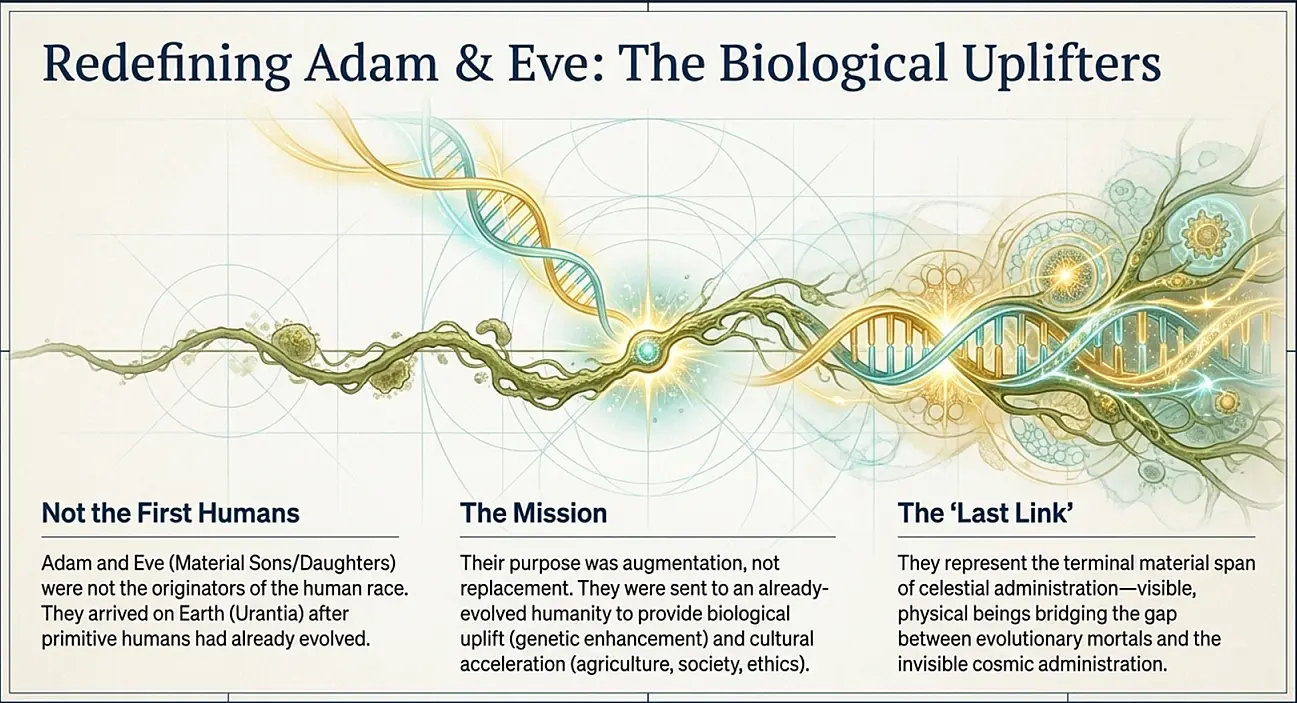
Adam and Eve are indispensable because they provide the first supra-human and the last celestial expression of this progression: celestial beings who are nevertheless physical, visible, socially accessible, and ultimately ancestral to the planetary races. They do not constitute the whole bridge between God and humanity; they complete its terminal material span.
Adam and Eve are not the conclusion of planetary ministry. They are the biological and cultural hinge between primitive evolution and the more advanced dispensations that follow.
The Magisterial Son and a New Planetary Order
On a normal world, the Adamic dispensation eventually prepares the way for the arrival of a Magisterial Son of the Avonal order. The Avonals are Paradise Sons. Their missions involve judgment, dispensational transition, spiritual advancement, and the further coordination of planetary administration.
The arrival of a Magisterial Son does not render the work of the Planetary Prince or the Material Son obsolete. Instead, their educational and administrative efforts are brought into a more unified planetary order. Paper 51 describes the union of these previously distinct forms of supervision as producing a new and effective system of world administration.
This is an important feature of the revelatory model.
Progress does not occur simply by placing one celestial ruler after another at the top of a hierarchy. Each stage reorganizes and coordinates the accumulated contributions of earlier ministries. Planetary advancement is architectural and holarchical. New levels of administration integrate the competencies already present.
The divine plan does not culminate merely in an efficient civilization. Its goal is a civilization increasingly governed by truth, beauty, goodness, love, service, and freely chosen spiritual loyalty.
On some worlds, a Magisterial Son remains for an extended age, and the planet prospers under the combined leadership of the Planetary Prince, the Material Son, and the Magisterial Son. Their roles are distinguishable but mutually reinforcing:
- the Planetary Prince remains associated with the long evolutionary and administrative history of the sphere;
- the Material Son and Daughter continue their cultural and planetary leadership;
- the Magisterial Son brings Paradise authority, judicial action, and a new spiritual dispensation.
The structure is not merely hierarchical. It is coordinated.
Bestowal and the Revelation of Divine Sonship
Every inhabited world eventually receives the bestowal of a Paradise Son. A Creator Son or Magisterial Son enters mortal life and reveals divine character through an actual creature existence.
Urantia’s bestowal Son was Christ Michael, incarnated as Jesus of Nazareth.
This bestowal was not a biological intervention or an administrative reorganization. Jesus’ life revealed the nature of God and the spiritual possibilities of human sonship. His gospel proclaimed that human beings could know God personally as Father and recognize themselves as members of a universal family.
The bestowal ministry thus advances planetary development at another level. Biological capacity, civilization, and social order are necessary, but they are not the final purpose of human evolution. They provide the setting within which persons can discover meaning, choose values, develop character, and enter conscious relationship with God.
The divine plan does not culminate merely in an efficient civilization. Its goal is a civilization increasingly governed by truth, beauty, goodness, love, service, and freely chosen spiritual loyalty.
The Trinity Teacher Sons and the Approach to Light and Life
As an evolutionary world approaches spiritual maturity, Trinity Teacher Sons may undertake repeated missions to the planet. These Paradise-origin instructors are not primarily judges or civil administrators. They are teachers of advanced truth. Their ministry deepens cosmic understanding, spiritual philosophy, and the integration of material knowledge with spiritual values.
The Teacher Sons build upon the accumulated work of all previous planetary ministers. They do not begin with primitive peoples incapable of receiving their instruction. They arrive when civilization, philosophy, religion, and planetary administration have matured sufficiently to support a more comprehensive spiritual culture. They may work with Magisterial Sons, finaliters, Material Sons, the Planetary Prince, and other celestial personalities already associated with the world. Once again, the pattern is cumulative and collaborative.
They may work with Magisterial Sons, finaliters, Material Sons, the Planetary Prince, and other celestial personalities already associated with the world. Once again, the pattern is cumulative and collaborative. The final Teacher Son mission inaugurates the era of "light and life"—the evolutionary destiny of inhabited worlds.
Light and life is not imposed instantaneously by divine decree. It is the outcome of a long developmental history involving physical evolution, biological uplift, civilizational progress, moral growth, spiritual revelation, celestial ministry, and countless creature decisions. God’s purpose becomes planetary fact through ages and ages of participation.
Urantia: A World Outside the Normal Sequence
Urantia did not experience this planetary progression normally. The rebellion of the Planetary Prince disrupted the early administration of the world. Adam and Eve arrived upon an isolated planet whose evolutionary races lacked the benefit of a successful preceding dispensation. Cut off from normal communication with their superiors and confronted with conditions far more difficult than those found on an ordinary world, they eventually departed from the prescribed plan.
Their default did not completely nullify their mission. Their descendants contributed biologically and culturally to later peoples, and portions of their religious teachings survived through the Sethite priesthood. But the intended worldwide program of gradual biological, cultural, and spiritual uplift was disrupted, requiring subsequent planetary plans to be modified in response to the emergency.
This distinction is essential when assessing the Adam and Eve story. The revelation does not present the later history of Urantia as the normal outcome of the Adamic plan. It presents that history as unfolding under altered conditions following the breakdown of the original program and the corrective measures made necessary by that failure.
The chronology in the Urantia Book is unusually specific. The revelation places Adam and Eve’s arrival approximately 38,000 years before 1934 and describes the later diffusion of Adamic “plasm” through portions of the human population.
The biblical memory of a lost garden, a transgression, and an expulsion can therefore be understood as the compressed cultural remnant of a much larger planetary tragedy. Yet the revelatory account does not teach hereditary guilt or the theological corruption of all subsequent humanity. The consequences were biological, cultural, administrative, and historical—not the divine condemnation of every human being born afterward.
Nor does the failure end the larger planetary purpose. Urantia continues to receive spiritual ministry. Michael’s bestowal as Jesus became the fourth epochal revelation. The Spirit of Truth was poured out upon the world. The papers themselves claim to constitute a fifth epochal revelation. The planet remains developmentally disordered, but it is not divinely abandoned.
The Genetic Correspondence: An Earlier Argument Revisited
The preceding sections have described creation by delegation as a cosmic and planetary pattern. But the Adamic mission makes an unusually concrete claim: that celestial ministry eventually enters directly into the biological history of an already existing humanity. If that account is substantially correct, its consequences would not belong only to theology. They would have entered the physical processes studied by genetics.
I examined genetic implications of the Adamic mission at length in my earlier essay, “Adam and Eve: Eight Feet Tall & Purple.” The central argument developed there is that The Urantia Book does not present Adam and Eve as the first humans or as replacements for evolutionary humanity. It presents them as biologic and cultural uplifters sent to augment a human population that had already evolved. After the default disrupted their original plan, Adam’s genetic “plasm”[ref] was introduced into selected human strains. In addition, Adam and Eve’s combined genes were distributed through the descendants of the violet race which Adam & Eve procreated in the first garden.
This new race--the violet race--consisted of the direct offspring of Adam and Eve. It was already underway before the default. They began their mission in the first garden with the deliberate goal of creating a pure line of descendants who would eventually interbreed with the evolutionary races of humanity to uplift their genetic stock. This process was part of the original plan and was well underway before the disruption caused by the default. The intended result was not the creation of a new humanity but the accelerated development of capacities already present within evolutionary humanity.
After the default, Adam and Eve relocated to the second garden, where they continued to have children. These later children were also part of the violet race, but the circumstances of their upbringing and the conditions of their mission had fundamentally changed. The original plan for a gradual and controlled genetic upliftment of humanity was no longer feasible. Instead, the genetic contribution of Adam and Eve through interbreeding with the evolutionary races, had to be accelerated because they were now no longer eternal. It was clearly much less efficacious than originally intended.
The chronology in the Urantia Book is unusually specific. The revelation places Adam and Eve’s arrival approximately 38,000 years before 1934 and describes the later diffusion of Adamic “plasm” through portions of the human population. Long after this account had been written, genetic research identified a history at the MCPH1 locus—commonly called microcephalin—that bears a striking correspondence to the revealed sequence. In 2006, Patrick Evans and his colleagues proposed that a group of MCPH1 variants known as haplogroup D[ref] had diverged from the lineage represented by other modern human variants approximately 1.1 million years ago, entered the modern human population through introgression approximately 37,000 years ago, and then rose rapidly in frequency under positive selection.
The significance lies not in the date alone. The proposed genetic history corresponds with the Adamic account at several related points:
- the contribution originated outside the population into which it entered;
- it entered through biological intermixture rather than ordinary mutation within that population;
- its introduction was placed near the revealed chronology of the Adamic arrival;
- and it subsequently spread with unusual rapidity under the influence of positive selection.
Taken together, these elements constitute more than a loose resemblance. They describe the same general pattern presented in the revelation: an external biological contribution entering an established human population at approximately the Adamic epoch and thereafter spreading widely because it conferred some adaptive advantage. My earlier essay above argued that the conjunction of date, mechanism, and diffusion represents one of the most provocative points of correspondence yet discovered between the revealed Adamic narrative and the emerging genetic history of humanity.
This argument does not require genetics to identify two individuals named Adam and Eve before the correspondence can be taken seriously. Historical genetics rarely identifies named prehistoric persons unless analyzing specific family ancestry. It reconstructs general population movements, divergence, interbreeding, inheritance, and selection from genetic traces left in living and ancient populations. The appropriate question is therefore not whether the MCPH1 research has “proven Adam and Eve,” but whether the pattern uncovered by genetics is the kind of pattern we should expect if the Adamic account is substantially true. In this case, the correspondence is striking enough that the question deserves serious consideration.
Divine purpose does not bypass natural process; it becomes effective through it.
Some scientific questions remain open. The MCPH1 haplogroup does not identify the population from which the contribution originated, and research has not demonstrated that this particular variant produced greater intelligence, larger brains, or any single measurable cognitive advantage. One sampled Neanderthal individual carried the ancestral non-D form, weakening the early suggestion that Neanderthals were the immediate source but leaving the source of the proposed archaic contribution unresolved. These qualifications define what has and has not yet been established by science; yet, they do not erase the underlying convergence of chronology, introgression, selection, and diffusion.
Indeed, subsequent paleogenomic research has moved the larger scientific picture closer to the kind of human history presupposed by the revelation. Interbreeding among modern humans, Neanderthals, Denisovans, and other archaic populations is now an established part of human evolutionary history, and adaptive introgression is recognized as one means by which useful genetic material entered and persisted in modern populations. The once-dominant picture of isolated human lineages advancing through mutation alone has been replaced by a far more relational history of migration, mixture, inheritance, and selection. And this is exactly how the Urantia Book delivers on this topic.
The MCPH1 correspondence should therefore be situated within the larger Adamic argument rather than treated as an isolated genetic curiosity. As developed in my earlier essay, the revelation supplies a coherent model: evolutionary humanity first appears through natural development; Adam and Eve arrive much later as biologic uplifters; their original mission defaults; a modified program introduces Adamic inheritance into selected human strains; and their descendants carry that contribution outward over many generations. The genetic findings do not yet disclose the whole history, but they reveal a pattern remarkably congenial to it. The correspondence does not bear the entire evidentiary weight of the Adamic narrative, nor does it need to. It stands as a substantial and still-developing point of coordination between revelation and science.
Different Questions, Coordinated Explanations
The deeper importance of the Adam and Eve story does not depend upon one gene. Its greater significance lies in the model of creation it illustrates.
Science can investigate how genetic material enters a population, how it spreads, and what biological effects it produces. The revelatory account asks a different question: whether such evolutionary processes might also operate within a larger framework of purpose and planetary development.
Coordination becomes possible when causation is understood as layered. Science and revelation need not compete.
The existence of a cellular mechanism does not prove that an organism has no goals. The existence of neural activity does not prove that personality is unreal. The existence of administrative procedures does not prove that an organization has no mission. Likewise, the existence of evolutionary mechanisms does not by itself prove that planetary development is devoid of purpose. Higher-level organization does not violate lower-level processes. It works through them.
Consider something much closer to home. The movement of a human hand can be explained through muscles, nerves, electrical impulses, and brain activity. But that physical explanation does not tell us why a person raised the hand—to greet a friend, cast a vote, or reach for a child. The physical mechanism is real, but it does not necessarily exhaust the meaning or purpose of the action.
A geneticist can describe how a variant entered a population and spread without addressing why a wider planetary administration might have intended biological uplift. A revelatory cosmology can propose purpose and agency without replacing the scientific investigation of physical mechanisms.
That said, religion exceeds its proper domain when it denies well-supported physical processes in order to preserve a literalized ancient narrative. Materialism exceeds science when it assumes that a physical account of mechanism has disproved every possible higher level of agency, purpose, or meaning.
Michael Levin's research shows how collections of cells can communicate, respond to problems, and coordinate their behavior toward larger anatomical outcomes even though no individual cell contains the complete plan. Organization arises through relationships among the parts. Levin's research provides a striking contemporary example of how higher levels of organization can enlarge what lower-level components are capable of accomplishing without abolishing the processes operating beneath them.
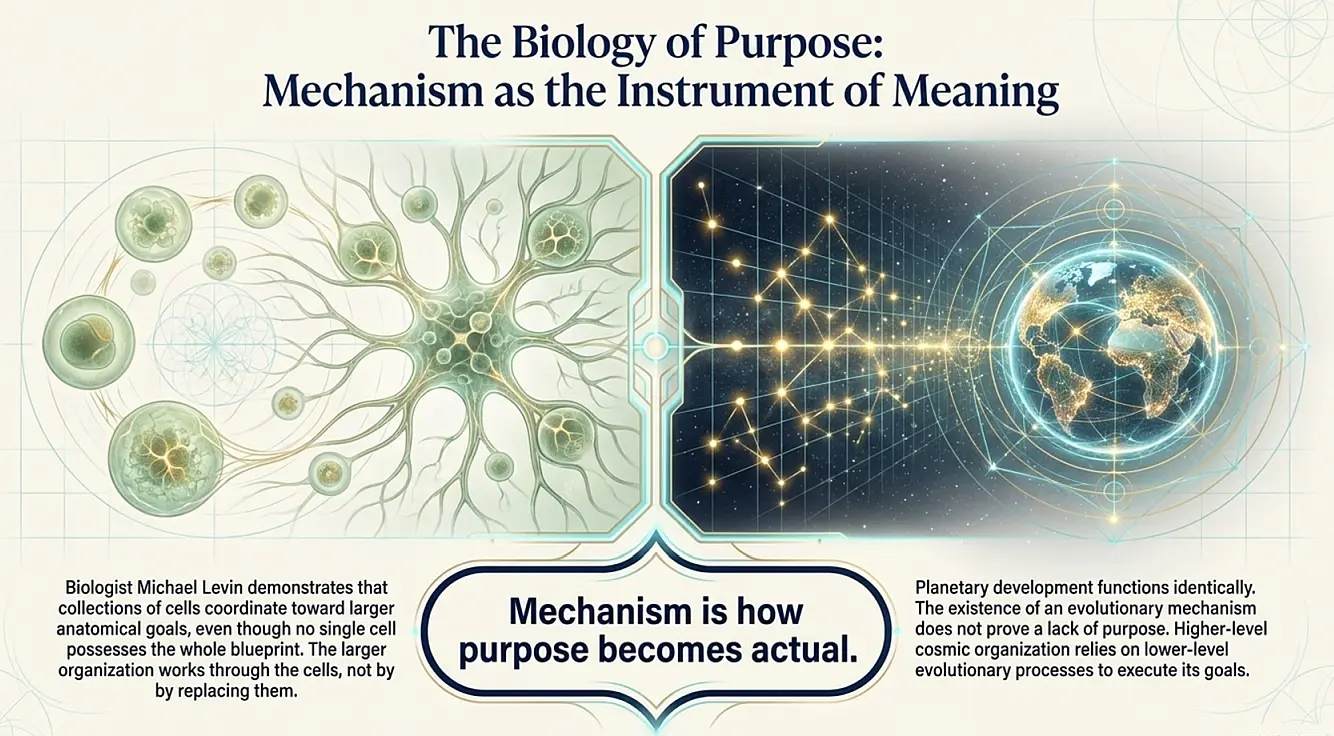
That principle reaches directly back to the central argument of this essay. The Urantia Book portrays creation not as God repeatedly substituting divine action for natural process, but as purpose progressively expressed through organized agencies, relationships, natural laws, evolutionary processes, and creature participation.
Creation by delegation is therefore not less divine because it operates through process. In this cosmology, that is precisely how divine purpose becomes actual.
From Origin to Destiny
The central contribution of The Urantia Book’s cosmogony is not merely a more elaborate account of what happened at the beginning of the universe. It is a vision of how purpose becomes reality.
From the differentiation of the Absolutes to the organization of the universes, from the initiation of life to the evolution of human beings, and from the ministry of Planetary Princes to the biological contribution of Material Sons, the judicial and dispensational work of Magisterial Sons, the revelatory bestowals of Paradise Sons, and the spiritual instruction of Trinity Teacher Sons, the same pattern appears repeatedly: reality advances through differentiated but coordinated agency.
Adam and Eve occupy an indispensable place within that progression, but they are neither the first nor the last agents of planetary development. They represent the stage at which celestial ministry enters directly into the biological and cultural inheritance of an evolving humanity.
The Magisterial Sons build upon that inheritance by coordinating planetary administration and inaugurating new dispensations. A bestowal Son reveals divine character within mortal life. The Trinity Teacher Sons deepen planetary wisdom and prepare the world for the era of light and life. The trajectory extends far beyond Eden.
Creation is not an event that occurred once in the remote past and then ceased. It is an unfolding process through which potentials become actual, isolated competencies become coordinated, and evolutionary creatures increasingly participate in the purposes of their Creator.
God is the source of the process, but creation is not accomplished by God alone.
The universe is populated by beings, nearly all are personalities, who receive responsibility, exercise agency, make decisions, encounter failure, correct error, minister to those below them, and contribute to realities greater than themselves. Even human beings eventually become participants in this pattern whenever they transform inherited possibilities into truth, beauty, goodness, service, and love.
The ultimate coordination of science and religion may therefore begin with a simple recognition: science discloses many of the processes through which the universe develops; religion seeks the meanings and values toward which development may be directed; and revelation proposes a larger architecture in which process, purpose, personality, and participation belong to one coherent reality.
In that cosmology, God does not become less sovereign by delegating creation. He becomes more lovable and increasingly understood.
// Bob Debold July 2026.